
CASSAVA
Commodity Overview
Cassava (Manihot esculenta) represents Nigeria's most important root crop and a cornerstone of food security, with annual production exceeding 60 million metric tons positioning Nigeria as the world's largest cassava producer. The crop's transformation from subsistence staple to industrial raw material through processing into High Quality Cassava Flour (HQCF) and cassava starch represents one of Nigeria's most significant agricultural value-chain opportunities, with government policies mandating cassava flour inclusion in bread (10-20%), biscuits, and other baked goods creating guaranteed domestic demand exceeding 2 million tons annually.
The economic significance of cassava extends beyond food security to encompass industrial applications, employment generation, and rural development. Cassava cultivation provides income to over 30 million farming households across Nigeria's diverse ecological zones, while processing facilities—ranging from small-scale community mills to large industrial plants—employ hundreds of thousands in rural areas. HQCF commands prices of ₦180-250 per kilogram (compared to ₦150-200 per kilogram for wheat flour), while cassava starch for industrial applications sells for ₦200-300 per kilogram, creating attractive margins for integrated production-processing operations.
Nigeria's cassava processing potential remains significantly underutilized despite possessing suitable conditions across all agro-ecological zones and government support through various cassava development programs. Recent initiatives including the Presidential Cassava Initiative and various state-level programs have mobilized investment in improved varieties, processing infrastructure, and market development to transform cassava from subsistence crop to industrial commodity.
Nigeria's Cassava Production Zones
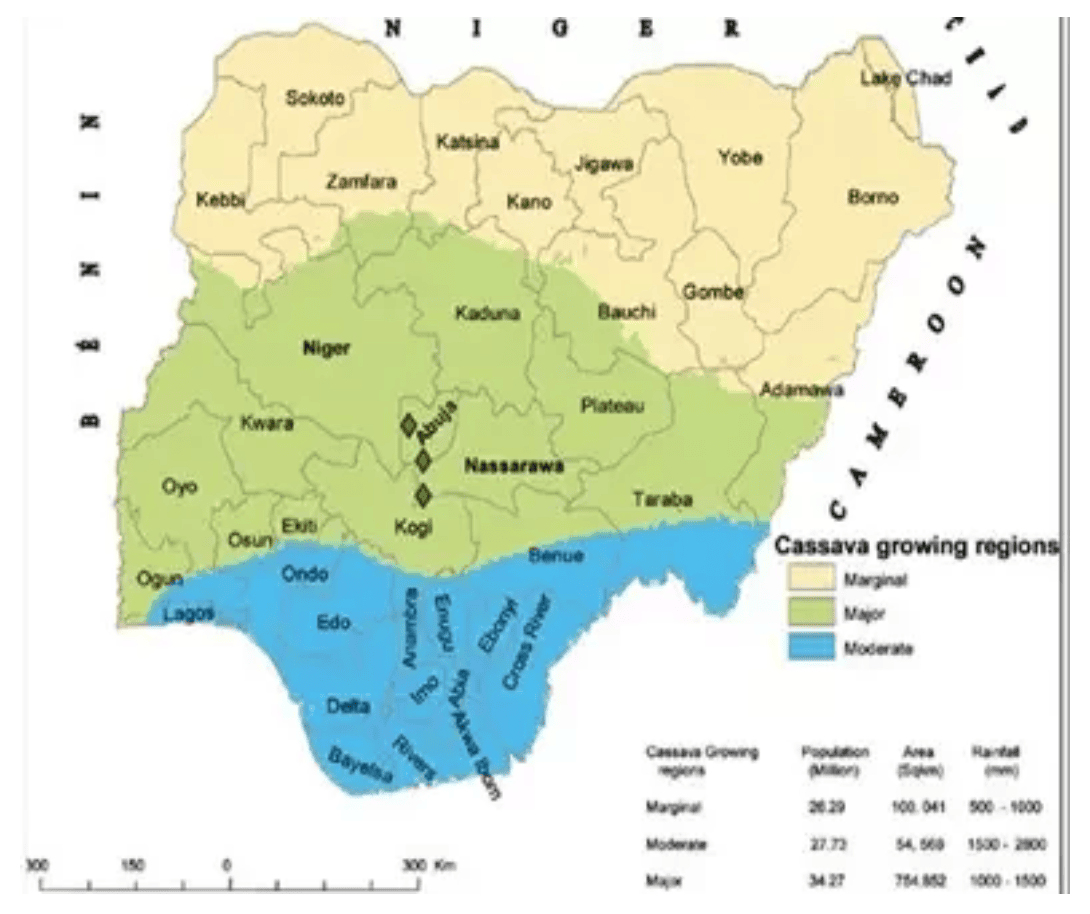
Top 3 Producing States
1. Benue State
Benue State commands the premier position among Nigeria's cassava producing states through exceptional production volumes, established processing infrastructure, and strategic location facilitating market access. The state accounts for approximately 15% of national cassava production, producing over 9 million metric tons annually from roughly 800,000 hectares under cultivation—making Benue Nigeria's undisputed "Cassava Capital." Benue's competitive advantage stems from its location in the Middle Belt with suitable rainfall patterns (1,000-1,400mm annually), well-drained loam to sandy-loam soils ideal for cassava cultivation, and appropriate temperatures. The state's nickname "Food Basket of the Nation" reflects its agricultural productivity, with cassava serving as the foundation of the state's agricultural economy.
The state hosts the highest concentration of cassava processing facilities in Nigeria, ranging from small-scale community mills producing garri (fermented cassava granules) to medium and large-scale facilities producing HQCF and cassava starch. Makurdi (state capital) serves as Nigeria's primary cassava trading hub with established market infrastructure connecting producers to processors and end-users.
Benue State Map
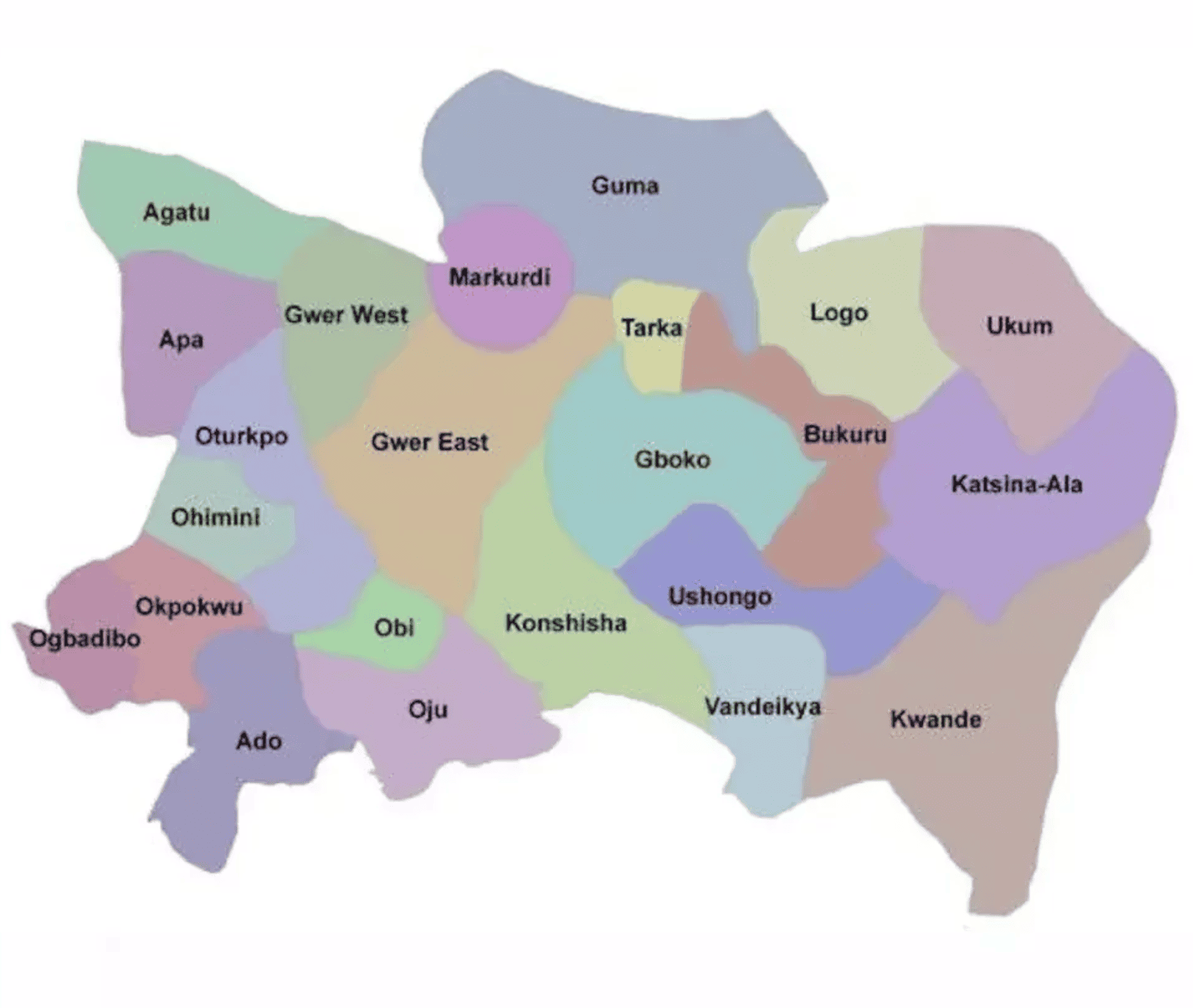
Best Regions/LGAs for Production
Primary LGA: Makurdi
Represents Benue State's premier cassava-producing zone and Nigeria's primary cassava trading hub. Located in central Benue with suitable rainfall (1,100-1,300mm annually), well-drained soils, and excellent road connectivity facilitating logistics. Hosts the highest concentration of cassava processing facilities creating strong demand for fresh roots.
Secondary LGA: Gboko
Ranks as Benue's second-most productive cassava zone, distinguished by its extensive areas of suitable land and established farming traditions. The area's good road connectivity to Makurdi (50km) facilitates market access while maintaining lower land costs than the state capital.
Tertiary LGA: Otukpo
Positioned in southern Benue with suitable rainfall and appropriate soils for cassava cultivation. The area's lower population density provides land availability for commercial-scale operations at competitive prices while maintaining good road access to Makurdi.
Growing Conditions

Climate
Tropical savanna climate with single rainy season (April-October) and dry season (November-March). Adequate rainfall during growing season supports cassava cultivation, while dry season facilitates harvesting and processing.

Soil Type
Well-drained loam to sandy-loam soils with good structure and adequate depth (40-60cm). pH 5.5-6.5 suitable for cassava. Cassava tolerates poor soils better than most crops but responds well to improved fertility.

Rainfall
Annual precipitation 1,000-1,400mm concentrated in single rainy season. Adequate for cassava's 10-12 month growing cycle. Cassava's drought tolerance allows successful production even with irregular rainfall.

Temperature
Warm temperatures 25-30°C during growing season ideal for cassava. Cassava tolerates high temperatures (up to 40°C) better than most crops, making it well-suited to tropical regions.

Altitude
Production at 100-400 meters elevation. Relatively flat terrain facilitates mechanization and large-scale operations.

Water Availability
Adequate rainfall during growing season eliminates irrigation needs. Cassava's exceptional drought tolerance allows successful production even with irregular rainfall. Dry season facilitates harvesting and processing.
Project Implementation Strategy
Phase 1: Land Preparation & Planting Material (Months 1-2)
Select suitable site with well-drained loam to sandy-loam soils, flat to gently rolling terrain suitable for mechanization, and good road access for fresh root transportation to processing facilities. Conduct plowing (20-30cm depth) and ridging (30-40cm high ridges) to ensure good drainage and facilitate harvesting. Source quality cassava stem cuttings (10,000-12,000 cuttings per hectare) from improved varieties (TMS varieties, IITA varieties) with high yield, disease resistance, and good processing qualities.
Phase 2: Planting & Early Growth (Months 3-5)
Plant stem cuttings (20-25cm length) at onset of rains (April-May) when soil moisture adequate. Plant on ridges at 1m x 1m spacing (10,000 plants per hectare). Apply minimal fertilizer (NPK 15-15-15 at 200-300 kg per hectare) if soil fertility is very low; cassava thrives on marginal soils with minimal inputs. Implement weed control during first 3-4 months when cassava is poor competitor.
Phase 3: Vegetative Growth (Months 6-9)
Monitor plant growth. Cassava requires minimal management during this phase. Implement pest monitoring for cassava mealybug, cassava green mite, and other pests. Cassava's drought tolerance allows successful production even with irregular rainfall during this phase.
Phase 4: Root Bulking & Maturation (Months 10-12)
Monitor root development. Cassava roots bulk significantly during final months before harvest. Optimal harvest timing depends on variety and intended use (fresh consumption at 10-12 months, processing at 12-18 months for maximum starch content).
Phase 5: Harvesting & Processing (Months 12-18)
Harvest cassava roots at optimal maturity (12-18 months for processing, 10-12 months for fresh consumption). Expect yields of 20-30 tons fresh roots per hectare (national average 15-20 tons per hectare; improved varieties and good management achieve 25-35 tons per hectare). Transport fresh roots to processing facility within 24-48 hours (cassava roots deteriorate rapidly after harvest). Process into HQCF (conversion ratio approximately 4:1 fresh roots to HQCF) or cassava starch (conversion ratio approximately 6:1 fresh roots to starch).
KEY ADVANTAGES & SUCCESS FACTORS
Highest Production Volumes
Calabar seaport provides direct export access, reducing costs by ₦15,000-20,000 per ton. Over 200 licensed buying agents create competitive markets. Ongoing road rehabilitation improves farm-to-market connectivity.
Established Processing Infrastructure
Highest concentration of buying agents in Nigeria. Proximity to export facilities means faster time-to-market. Strong cooperative networks facilitate collective marketing and premium market access.
Strategic Location
Century-long cocoa tradition creates deep knowledge. Cross River Cocoa Seedling Multiplication Center produces 2+ million improved seedlings annually. CRIN provides technical backstopping.
Technical Expertise
Cross River Cocoa Development Project provides subsidized inputs. CBN Anchor Borrowers' Program offers single-digit interest loans. Tax incentives and pioneer status for processors reduce investment costs.
Government Support
Well-developed supply chains ensure fertilizer and pesticide availability. State seedling center plus private nurseries provide improved planting materials. Equipment suppliers in Calabar provide processing machinery.
2. Cross River State
Cross River State secures the second position among Nigeria's cassava producing states through favorable agro-ecological conditions, high productivity per hectare, and strategic location with export potential. The state accounts for approximately 10% of national cassava production, producing over 6 million metric tons annually.
Cross River's competitive advantage stems from its location in the rainforest zone with year-round rainfall (2,000-2,500mm annually), rich forest soils, and high humidity creating optimal conditions for cassava growth. The state achieves among the highest cassava yields per hectare in Nigeria (25-35 tons per hectare compared to national average of 15-20 tons per hectare) due to favorable growing conditions.
Cross River State Map
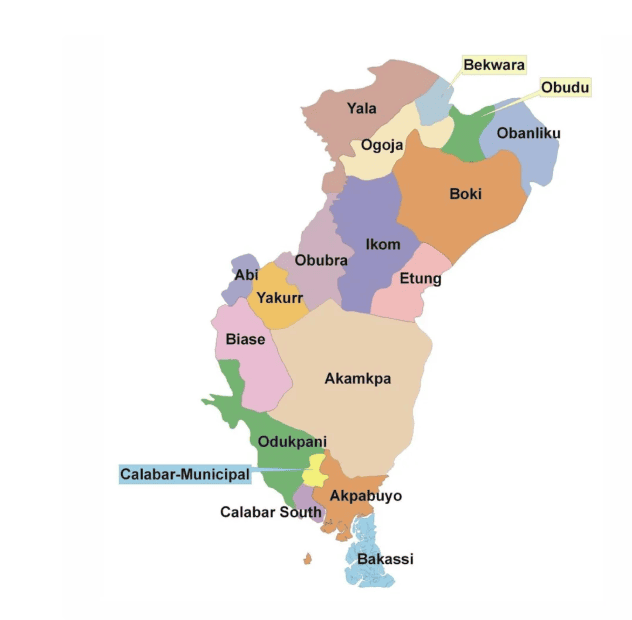
Best Regions/LGAs for Production
Primary LGA: Obubra
Represents Cross River State's premier cassava-producing zone, benefiting from optimal rainfall, rich forest soils, and established farming traditions. The area's high productivity per hectare and good road connectivity to Calabar create competitive advantages.
Secondary LGA: Yakurr
Ranks as Cross River's second-most productive cassava zone, distinguished by its extensive areas of suitable land and favorable growing conditions. The area's proximity to Calabar (100km) provides market access and processing facility connections.
Tertiary LGA: Abi
Positioned in the central part of the state, offers suitable rainfall, appropriate soils, and good road connectivity. The area's developing cassava production creates opportunities for processing infrastructure investment.
Growing Conditions
Climate
Humid tropical rainforest climate with year-round rainfall and high humidity. Bimodal rainfall pattern with major season April-July and minor season September-November supports continuous cassava growth.
Soil Type
Deep, well-drained forest soils (Ferralsols and Acrisols) with high organic matter (4-7%) and pH 5.5-6.5. Rich soils support high cassava productivity.
Rainfall
Annual precipitation 2,000-2,500mm distributed across 180-200 rain days. Abundant rainfall supports optimal cassava growth and high yields.
Temperature
Stable temperatures year-round with daily maximums 28-32°C and minimums 21-24°C. Ideal warm, moist conditions for cassava growth.
Altitude
Production occurs 50-300 meters above sea level. Lower elevations have deeper alluvial soils, higher elevations have better drainage.
Water Availability
Abundant year-round rainfall eliminates irrigation needs. High humidity maintains moisture even during brief dry periods.
Project Implementation Strategy
Phase 1: Land Preparation & Planting Material (Months 1-2)
Select suitable site with well-drained loam to sandy-loam soils, flat to gently rolling terrain suitable for mechanization, and good road access for fresh root transportation to processing facilities. Conduct plowing (20-30cm depth) and ridging (30-40cm high ridges) to ensure good drainage and facilitate harvesting. Source quality cassava stem cuttings (10,000-12,000 cuttings per hectare) from improved varieties (TMS varieties, IITA varieties) with high yield, disease resistance, and good processing qualities.
Phase 2: Planting & Early Growth (Months 3-5)
Plant stem cuttings (20-25cm length) at onset of rains (April-May) when soil moisture adequate. Plant on ridges at 1m x 1m spacing (10,000 plants per hectare). Apply minimal fertilizer (NPK 15-15-15 at 200-300 kg per hectare) if soil fertility is very low; cassava thrives on marginal soils with minimal inputs. Implement weed control during first 3-4 months when cassava is poor competitor.
Phase 3: Vegetative Growth (Months 6-9)
Monitor plant growth. Cassava requires minimal management during this phase. Implement pest monitoring for cassava mealybug, cassava green mite, and other pests. Cassava's drought tolerance allows successful production even with irregular rainfall during this phase.
Phase 4: Root Bulking & Maturation (Months 10-12)
Monitor root development. Cassava roots bulk significantly during final months before harvest. Optimal harvest timing depends on variety and intended use (fresh consumption at 10-12 months, processing at 12-18 months for maximum starch content).
Phase 5: Harvesting & Processing (Months 12-18)
Harvest cassava roots at optimal maturity (12-18 months for processing, 10-12 months for fresh consumption). Expect yields of 20-30 tons fresh roots per hectare (national average 15-20 tons per hectare; improved varieties and good management achieve 25-35 tons per hectare). Transport fresh roots to processing facility within 24-48 hours (cassava roots deteriorate rapidly after harvest). Process into HQCF (conversion ratio approximately 4:1 fresh roots to HQCF) or cassava starch (conversion ratio approximately 6:1 fresh roots to starch).
KEY ADVANTAGES & SUCCESS FACTORS
Highest Yields Per Hectare
Optimal growing conditions produce 25-35 tons per hectare, 50-75% higher than national average
Year-Round Production
Bimodal rainfall pattern enables flexible planting and harvesting schedules
Export Potential
Calabar port provides access to export markets for cassava products
Rich Soils
Forest soils with high organic matter support high productivity with minimal fertilization
Processing Opportunities
Developing processing infrastructure creates value-addition potential
3. Kogi State
Kogi State secures the third position among Nigeria's cassava producing states through suitable conditions, strategic location at the confluence of Niger and Benue rivers, and good market access to both northern and southern Nigeria. The state accounts for approximately 8% of national cassava production, producing over 4.5 million metric tons annually.
Kogi's competitive advantage stems from its strategic central location providing access to multiple markets, good road connectivity along major north-south routes, and suitable growing conditions across diverse ecological zones. The state's position at the confluence of Nigeria's two major rivers creates opportunities for water-based transportation and irrigation for dry season production.
Kogi State Map
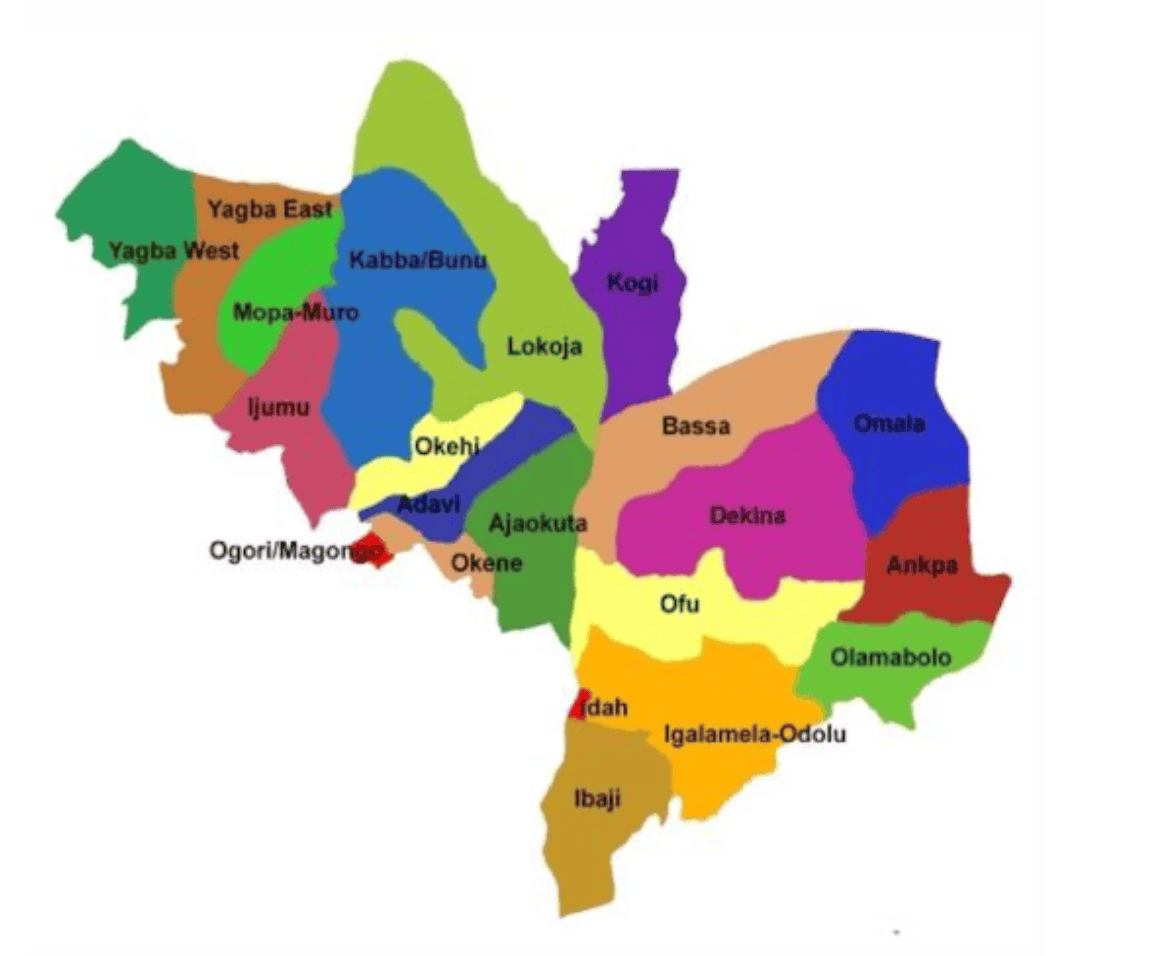
Best Regions/LGAs for Production
Primary LGA: Ankpa
Represents Kogi State's premier cassava-producing zone, benefiting from suitable rainfall (1,200-1,500mm annually), appropriate soils, and good road connectivity. The area's established cassava farming traditions and proximity to Benue State provide technical knowledge and market connections.
Secondary LGA: Dekina
Ranks as Kogi's second-most productive cassava zone, distinguished by its extensive areas of suitable land and strategic location along major transportation routes. The area's good road connectivity facilitates market access to both northern and southern markets.
Tertiary LGA: Ofu
Positioned along the Benue River, offers advantages through water availability for irrigation and potential water-based transportation. The area's suitable growing conditions and developing cassava production create opportunities for commercial operations.
Growing Conditions
Climate
Tropical savanna climate transitioning between southern rainforest and northern savanna zones. Adequate rainfall (1,000-1,500mm annually) varies across state with southern areas receiving more rainfall.
Soil Type
Varied soils from loam to sandy-loam with adequate drainage. pH 5.5-6.5, moderate fertility. Soil conditions vary across state with southern areas having richer soils.
Rainfall
Annual precipitation 1,000-1,500mm adequate for cassava cultivation. Southern areas receive higher rainfall (1,300-1,500mm), northern areas receive lower rainfall (1,000-1,200mm) but sufficient given cassava's drought tolerance.
Temperature
Warm temperatures 25-30°C suitable for cassava growth. Temperature regime similar to Benue State.
Altitude
Production at 100-400 meters elevation. Relatively flat terrain near rivers, gently rolling terrain in upland areas.
Water Availability
Adequate rainfall during growing season. Access to Niger and Benue rivers provides irrigation potential for dry season production and water-based transportation.
Project Implementation Strategy
Phase 1: Land Preparation & Planting Material (Months 1-2)
Select suitable site with well-drained loam to sandy-loam soils, flat to gently rolling terrain suitable for mechanization, and good road access for fresh root transportation to processing facilities. Conduct plowing (20-30cm depth) and ridging (30-40cm high ridges) to ensure good drainage and facilitate harvesting. Source quality cassava stem cuttings (10,000-12,000 cuttings per hectare) from improved varieties (TMS varieties, IITA varieties) with high yield, disease resistance, and good processing qualities.
Phase 2: Planting & Early Growth (Months 3-5)
Plant stem cuttings (20-25cm length) at onset of rains (April-May) when soil moisture adequate. Plant on ridges at 1m x 1m spacing (10,000 plants per hectare). Apply minimal fertilizer (NPK 15-15-15 at 200-300 kg per hectare) if soil fertility is very low; cassava thrives on marginal soils with minimal inputs. Implement weed control during first 3-4 months when cassava is poor competitor.
Phase 3: Vegetative Growth (Months 6-9)
Monitor plant growth. Cassava requires minimal management during this phase. Implement pest monitoring for cassava mealybug, cassava green mite, and other pests. Cassava's drought tolerance allows successful production even with irregular rainfall during this phase.
Phase 4: Root Bulking & Maturation (Months 10-12)
Monitor root development. Cassava roots bulk significantly during final months before harvest. Optimal harvest timing depends on variety and intended use (fresh consumption at 10-12 months, processing at 12-18 months for maximum starch content).
Phase 5: Harvesting & Processing (Months 12-18)
Harvest cassava roots at optimal maturity (12-18 months for processing, 10-12 months for fresh consumption). Expect yields of 20-30 tons fresh roots per hectare (national average 15-20 tons per hectare; improved varieties and good management achieve 25-35 tons per hectare). Transport fresh roots to processing facility within 24-48 hours (cassava roots deteriorate rapidly after harvest). Process into HQCF (conversion ratio approximately 4:1 fresh roots to HQCF) or cassava starch (conversion ratio approximately 6:1 fresh roots to starch).
KEY ADVANTAGES & SUCCESS FACTORS
Strategic Central Location
Access to both northern and southern markets provides marketing flexibility
Good Road Connectivity
Major north-south routes facilitate transportation to diverse markets
River Access
Niger and Benue rivers provide irrigation potential and water-based transportation
Market Diversification
Central location enables serving multiple markets reducing dependence on single market
Lower Competition
Less saturated cassava processing sector compared to Benue State creates opportunities for new investments
Conclusion
Cassava production and processing represents Nigeria's most significant agricultural value-chain opportunity combining food security, industrial applications, and government support. Benue State offers highest production volumes with established processing infrastructure and market access. Cross River State provides highest yields per hectare with optimal growing conditions and export potential. Kogi State demonstrates strategic location advantages with access to diverse markets and river-based transportation.